Jason Jones’ Testimony
By Jason Jones, as told by Liz Charlotte Grant. Jason Jones is an Elder and the Pastor of Care and Counseling at Park Church.
This Sunday will be week four of Ephesians at Park Church. As our society continues its trend toward self-centered and superficial worldviews, many have adopted a watered-down view of God that that leads us away from the glory we were made to enjoy. Ephesians shatters this diluted view of God by putting the weight of His glory in our faces in a way that is overwhelming and life-transforming.
Here’s how you can prepare for this Sunday:
What have we done to deserve these overwhelming and glorious blessings from God—love, redemption, forgiveness, grace, adoption, hope, honor, and power? Paul’s answer is emphatic: nothing. Nothing at all. In fact, he says, we were all dead in trespasses and sin, walking away from God in disobedience, following God’s enemy toward destruction. That was our hopeless situation when God burst into our lives with His breathtaking love, mercy, and grace.
To all who are weary and need rest,
To all who mourn and long for comfort,
To all who feel worthless and wonder if God cares,
To all who fail and desire strength,
To all who sin and need a Savior,
This church opens wide her doors
with a welcome from Jesus Christ,
the Ally of His enemies, the Defender of the guilty,
the Justifier of the inexcusable, the Friend of sinners.
Welcome!
Yes And Amen (Anthony Brown, Chris McClarney, Nate Moore)
His Mercy Is More (Matt Boswell, Matt Papa)
Heavenly Father, We admit to you today that we often live as though we were still dead in our trespasses and sins. You have made us alive in Christ and given us your Holy Spirit, yet our slowly-maturing souls dwell in sinful bodies, and we continue to gratify the desires of our flesh in countless ways. We eat too much, drink too much, and indulge in sinful fantasy and practice, medicating ourselves to escape reality and entertaining ourselves to distract from pain. We follow the course of the world around us, giving in to pressure from our friends and our circumstances, instead of living with our eyes fixed on our heavenly home. We frantically fill ourselves up with pleasures, using your good gifts to us as a way to avoid our great need for you. Father, forgive us.
Rock Of Ages (Mary Elizabeth Byrne, Eleanor Henrietta Hull, arr. Charlie Hall)
Break Every Chain (Will Reagan, arr. Tasha Cobbs)
Living Hope (Brian Johnson, Phil Wickham)
All I Have is Christ (Jordan Kauflin)
By Nikki, as told by Liz Grant
We’re in week three of Ephesians. As our society continues its trend toward self-centered and superficial worldviews, many have adopted a watered-down view of God that that leads us away from the glory we were made to enjoy. Ephesians shatters this diluted view of God by putting the weight of His glory in our faces in a way that is overwhelming and life-transforming.
Here’s how you can prepare for this Sunday:
Paul gives us a window into his own daily prayer life as he expresses his continual plea for the Holy Spirit to empower the children of God to know—not merely in their heads, but in the depth of their hearts—the unshakable hope, supreme value, and immeasurable power that is available to those who are united to the resurrected Jesus through faith. The power that is available to those who are in Christ is the same power of God that raised Jesus from the dead and exalted Him as the ruler of the whole world.
To all who are weary and need rest,
To all who mourn and long for comfort,
To all who feel worthless and wonder if God cares,
To all who fail and desire strength,
To all who sin and need a Savior,
This church opens wide her doors
with a welcome from Jesus Christ,
the Ally of His enemies, the Defender of the guilty,
the Justifier of the inexcusable, the Friend of sinners.
Welcome!
Fall Afresh (Jeremy Riddle)
How Great Thou Art (Stuart K. Hine)
Eternal and merciful God,
You have loved us with a love beyond our understanding,
and You have set us on paths of righteousness for Your name’s sake.
Yet we have strayed from Your way;
we have sinned against You in thought, word, and deed,
through what we have done and what we have left undone.
As we remember the lavish gift of Your grace
symbolized in baptism, O God,
we praise You and give You thanks that You forgive us yet again.
Grant us now, we pray, the grace to die daily to sin,
and to rise daily to new life in Christ,
who lives and reigns with You,
and in whose strong name we pray. Amen.
Be Thou My Vision (Mary Elizabeth Byrne, Eleanor Henrietta Hull, arr. Ascend The Hill)
Broken Vessels (Amazing Grace) (Joel Houston, Jonas Myrin)
The Love Of God (Frederick Martin Lehman, Meir Ben Isaac Nehorai, arr. Sara Groves)
Through And Through/Set A Fire (Will Reagan)
This is week two of Ephesians at Park Church. As our society continues its trend toward self-centered and superficial worldviews, many have adopted a watered-down view of God that that leads us away from the glory we were made to enjoy. Ephesians shatters this diluted view of God by putting the weight of His glory in our faces in a way that is overwhelming and life-transforming.
Here’s how you can prepare for this Sunday:
What does it mean to be blessed? Is it merely good circumstances? Material provision? Paul begins his letter with a beautiful poetic expression of praise to God for all that God has done to bless those who are “in Christ” He outlines these blessings in one of the most powerful and elaborate sentences ever written. In love, God predestined people from all nations to be adopted into His family as sons and daughters through the work of Jesus. Jesus has redeemed us from slavery to sin, forgiven us by His blood, and lavished His grace upon us to unite us to Himself as sons and daughters of God by the power of the Holy Spirit. He did all of this in order that the whole world might know and treasure His glorious grace.
To all who are weary and need rest,
To all who mourn and long for comfort,
To all who feel worthless and wonder if God cares,
To all who fail and desire strength,
To all who sin and need a Savior,
This church opens wide her doors
with a welcome from Jesus Christ,
the Ally of His enemies, the Defender of the guilty,
the Justifier of the inexcusable, the Friend of sinners.
Welcome!
10,000 Reasons (Jonas Myrin, Matt Redman)
Doxology (Amen) (Louis Bourgeois, Thomas Ken, Phil Wickham)
Almighty God, to You all hearts are open, all desires known, and from You no secrets are hid: Cleanse the thoughts of our hearts by the inspiration of Your Holy Spirit, that we may perfectly love You, and worthily magnify Your holy Name; through Christ our Lord. Amen.
Lord I Need You (Carson, Maher, Nockels, Reeves, Stanfill)
Come Thou Fount (Above All Else) (Shane Barnard, Robert Robinson, John Wyeth)
Ever Be (Strand, Greely, Wilson, Heiligenthal)
O Praise The Name (Anástasis) (Benjamin Hastings, Marty Sampson, Dean Ussher)
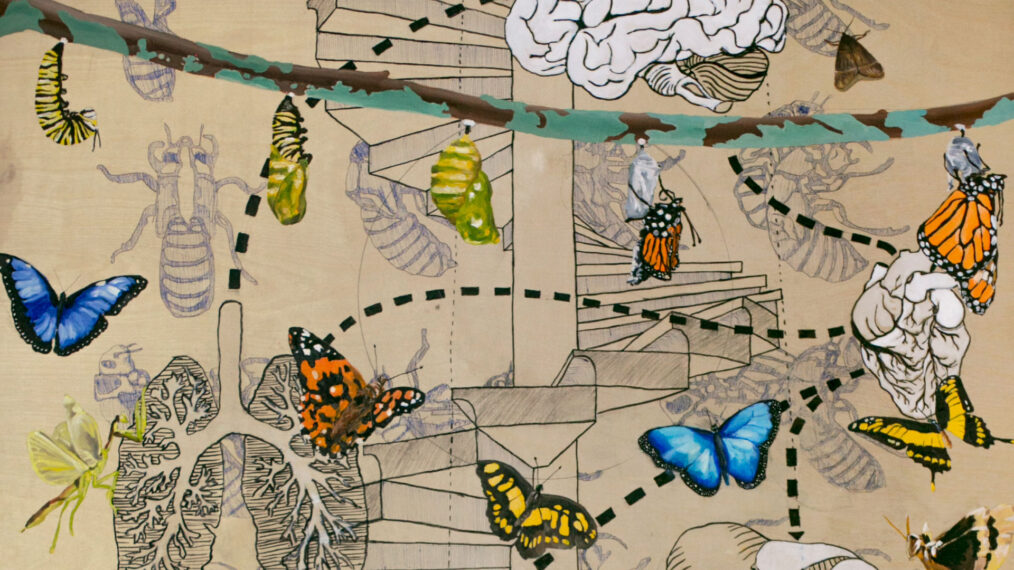
We commissioned Benjamin Rogers to create an original art piece for our series in Ephesians. Benjamin is a full-time instructor of art at Red Rocks Community College. He has an MFA in painting from Arizona State University and his work has been exhibited across the country. He based his work for this piece on several arguments from the text. Here’s how he describes it…
In creating this piece, I tried to visually connect some of the themes present in Ephesians. Many of these themes are somewhat unrelated in subject matter, so I had to develop a way to allude to them in a tangential manner. This essay isn’t intended to explain 100% of the meaning within this piece, but simply to give you some insight into my thought process.
Ephesians 2:19–21 talks about people in the church as “…no longer being aliens and strangers but members of the household of God”. This led me to use vastly different imagery within the same piece in a way that felt cohesive. The resultant image is almost collage-like, but the overall feeling, if nothing else, emphasizes the colorful top layer over top of the monochromatic(ish) layers underneath. This visually communicates a theme of blossoming, new life, as if waking from a dream.
The bottom visual layer is a pattern made from the life cycle of the cicada. I used the cicada’s life cycle because they remain under the ground for 17 years as nymphs, then emerge and molt their shell and live in the light of day for a couple of weeks and die. This process of climbing out of the ground and living in the light reminded me of Ephesians 4:22–24. This was the inspiration for painting moths and butterflies, as well as the life cycles of a frog and monarch butterfly. The bottom and top layers act as conceptual bookends illustrating the same concept. However, one is generally thought of as beautiful while the other is generally thought of as gross. I really like this dichotomy and think that it is pretty illustrative of human institutions.
Ephesians 4:1–16 immediately alludes to a physical body, which only functions properly when all organs work together in unity. This illustration of the workings of the church body is a beautiful analogy, because it demonstrates that there is a lot of unappealing, unappreciated work that is necessary for the Church to flourish. My goal was to illustrate anatomical renderings of some essential human organs, some whose function is obvious and well known and others which aren’t as recognizable or well-understood. I used the implied line to demonstrate the working relationship between them.
Perhaps the least recognizable theme illustrated in the painting is that of submission, which arises in Ephesians 5:22 and 6:1–9. My thinking on the theme of submission is that items are to be placed in their proper order. To depict this, I used a spiral staircase, because if the stairs aren’t laid in the correct order then the structural integrity is compromised. If people aren’t willing to submit themselves to the appropriate authority, whatever or whomever that is, then the system is compromised and may fall apart. The staircase also acts as a static visual anchor for the rest of the imagery on the painting. It provides a structure through which the rest of the visual elements can interact.